Amino acids: the building blocks of proteins
Extra knowledge
An amino acid is a small molecule. Think of it as a person with four arms: in the middle is a single carbon atom, and one group is attached to each of its four "arms".
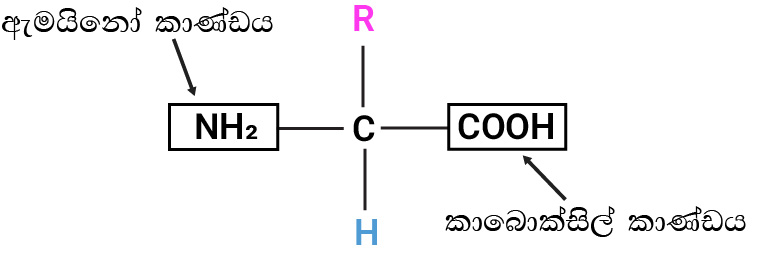
The four groups attached to the central carbon atom
Amino group
–NH2
This is where the molecule's nitrogen is
Carboxyl group
–COOH
This is what gives the molecule the name "acid"
Hydrogen atom
–H
The same in every amino acid
Variable group
–R
A group containing carbon and hydrogen that changes from one amino acid to another
Only the R group is different
Compare any two amino acids. The three groups –NH2, –COOH and –H are the same in both. They differ only in the R group. Because the R group takes 20 different forms, there are 20 kinds of amino acid.
Amino acids are like an alphabet of 20 letters.
From a tiny bacterium to an elephant and a human, every protein in every living thing in the world is built by joining these 20 amino acids in different orders. Just as an alphabet of 20 letters can write endless words and books, these 20 units can build any protein that life needs.
The simplest amino acid
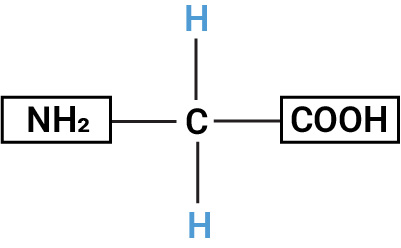
Of the 20 amino acids, glycine has the simplest structure. Its R group is just a single hydrogen atom (H), so it has almost no R group at all.
Essential amino acids
Some amino acids cannot be made by our bodies on their own. The only way to get them is from food. That is why they are called essential amino acids. This is also why we need a balanced meal that includes a variety of foods.