Tests to identify carbohydrates
You cannot tell just by looking whether a food contains starch or sugar. But a few simple laboratory tests make it easy to find out whether starch, monosaccharides or disaccharides are present.
TEST Test for starch
- Put a small piece of the food you want to test into a test tube, add a little water, and crush and mix it well.
- Add a drop of iodine solution to it.
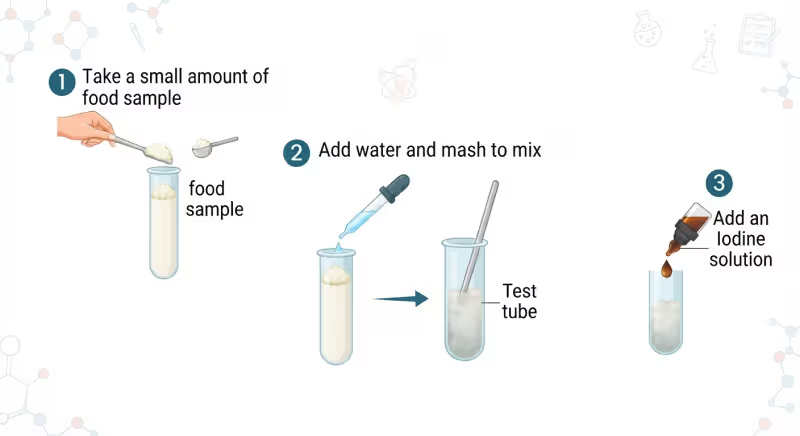
Observation
If starch is present, the mixture turns a dark blue colour tending towards purple (blue-black).
TEST Test for monosaccharides and some disaccharides (Benedict's test)
- Put a little glucose solution into a test tube.
- Add Benedict's solution little by little.
- Stand the tube in a water bath and heat it gently.
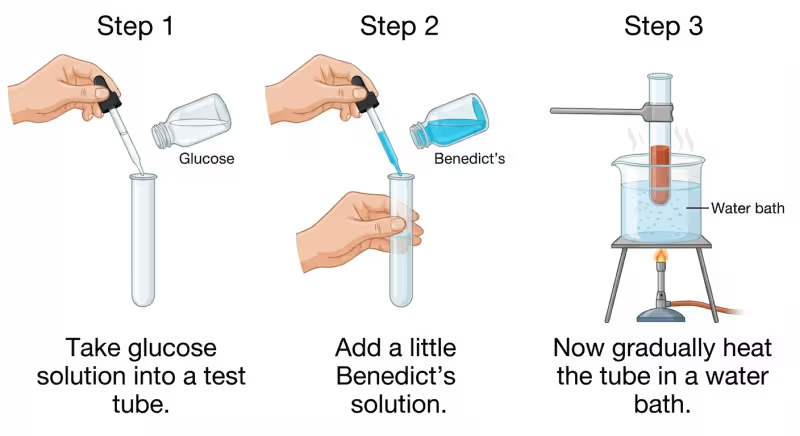
Observation — the colour change
As it heats, the colour changes step by step, and finally a brick red precipitate settles at the bottom of the tube.
TEST Test for a disaccharide (sucrose)
- Put a little sugar (sucrose) solution into a test tube.
- Add Benedict's solution little by little.
- Stand the tube in a water bath and heat it gently. This time no change is seen.
- Now add a few drops of dilute sulphuric acid and heat it again.
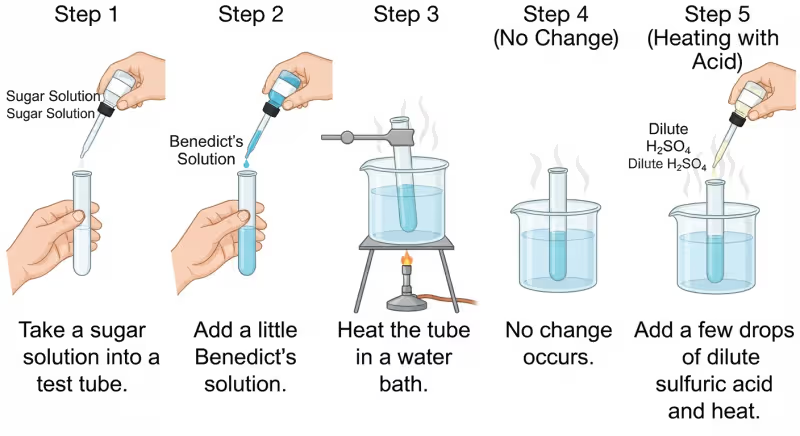
Observation
After the acid is added and the tube is heated, the same colour change seen with glucose now takes place, giving a brick red precipitate.
Why does the result appear only after the acid is added?
A sucrose molecule cannot react with Benedict's solution directly. When it is heated with a dilute acid, sucrose is hydrolysed and splits into its two parts, glucose and fructose. It is these monosaccharides that then react with Benedict's solution.
Sources
- Carbohydrates — OpenStax Biology 2e
- Classification of Carbohydrates — Chemistry LibreTexts
- Carbohydrates — OpenStax Microbiology (Lumen Learning)
- Fructose — Wikipedia
- Lactose — Wikipedia
- Does breast milk contain lactose? — Medical News Today
- Dietary fiber — Wikipedia
- Lab 9 — Tests for Carbohydrates — Chemistry LibreTexts
- Testing for Biological Molecules (Benedict's, Iodine, Emulsion, Biuret) — Microbe Notes