Monosaccharides
What gives a ripe mango or a spoonful of honey its sweet taste? It is simple sugars — that is, monosaccharides. Monosaccharides are the building units of carbohydrates. All the other carbohydrates are built when these units join to one another in different ways.
How do we recognise monosaccharides?
- They exist as crystals.
- They dissolve easily in water.
- They taste sweet.
The three members of this group we meet most often are glucose, fructose and galactose.
Comparing the three monosaccharides
| Type | Where it is found | Facts to know |
|---|---|---|
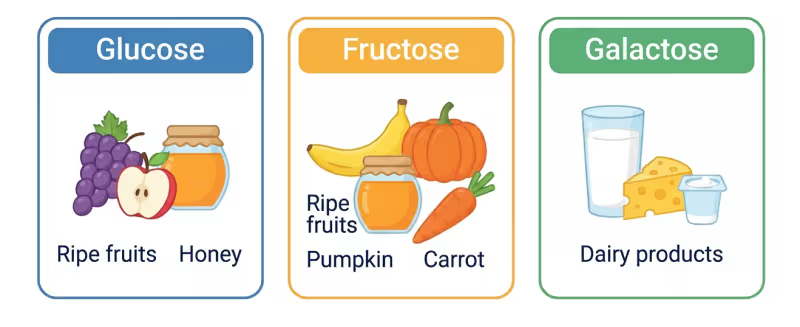
| Glucose | Ripe fruit, honey |
|
| Fructose | Ripe fruit, honey, pumpkin, carrot |
|
| Galactose | Milk foods |
|
Extra knowledge — the shape of a glucose molecule
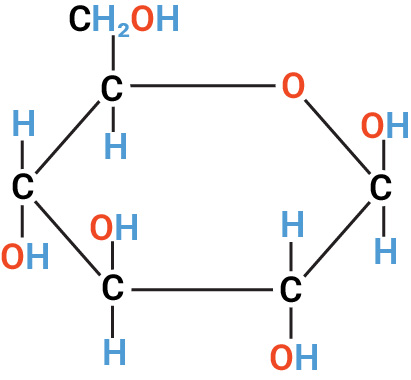
A glucose molecule is like a ring with six corners — a hexagonal ring. Five of the six corners hold carbon atoms and one holds an oxygen atom. Several hydroxyl (–OH) groups and one –CH2OH group are attached to the outside of the ring.
These –OH groups are why glucose dissolves easily in water. They also act as the "hands" two glucose molecules use to hold on to each other.