Polysaccharides
"Poly" means "many". A polysaccharide forms when a large number of monosaccharide molecules join together like a long chain (polymerise). If this chain is hydrolysed, it breaks back down into monosaccharides.
Shared properties
Unlike the sugars, polysaccharides have rather different properties. They are easy to remember if you think of a grain of rice or a sheet of paper (cellulose):
- They do not dissolve in cold water.
- They do not exist as crystals.
- They are not sweet.
The same unit — different results
Cellulose, starch and glycogen all have the same building unit: glucose. So why are they different from one another? Because the number of glucose molecules in the chain, and the way they are linked to each other, differ. With the same kind of brick you can build a house, a wall or a monument; in the same way, glucose molecules combining in different ways give different results.
Comparing the three polysaccharides
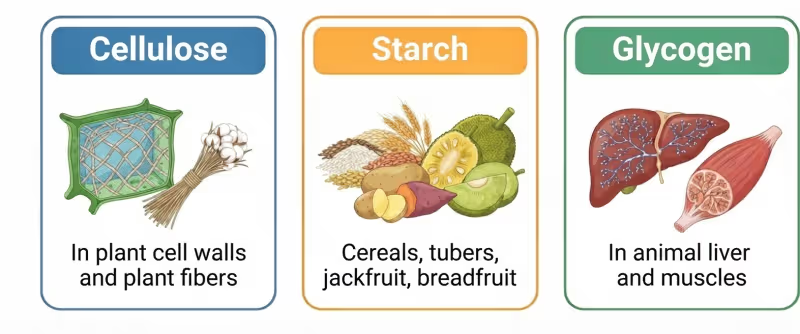
| Type | Where it is found | Facts to know |
|---|---|---|
| Cellulose | The cell walls of plant cells, the fibres in plants | Humans cannot digest cellulose, so it gives us no nutrition. Even so, this fibre in our food prevents constipation. |
| Starch | Grains, yams, jackfruit, breadfruit | Plants store their excess carbohydrate as starch. |
| Glycogen | Animal liver and muscles | Animals store the excess carbohydrate in their bodies as glycogen. |
Remember
Starch — the plant's food store. Glycogen — the animal's food store. Cellulose — the material that builds the plant's body.